
Great Expectations of Goodness
There was ice in the forecast, precious family members were going to be on the roads, and I was fighting the “what ifs.” My heart sank as I was reminded of an observation shared with me a few years ago by someone who knows me well and loves me a whole lot: “I am so sorry that you have experienced the worst-case scenario enough times that in potentially dangerous situations you imagine the worst.” Initially I was completely taken-aback, then appalled and deeply saddened. For most of my life I’d have insisted that “the glass is half full!” As I sat with Jesus, reflecting on the painful reality that my friend had voiced, I had to admit that it was true. And it needed to change. I needed Jesus to help me rediscover and practice the expectation of good.
Over the past several months I’ve been pondering why Jesus was so insistent that we become childlike and why we seem to hear so little in our churches or in the wider Christian community about something that was clearly important to Him. I suspect it may have to do with “childlike” getting lumped in with “childish” and being summarily discarded as immaturity. Yet Jesus told His disciples, “Believe me, …unless you change your whole outlook and become like little children you will never enter the kingdom of Heaven” (Matt 18:3). Without a doubt, Jesus was highlighting the beautiful faith of a child. But I believe there is so much more that we can learn from children – qualities that He desires for us. Children embody wonder and curiosity, they love without reservation, trust without fear, show up without pretense, celebrate every tiny victory, live with utter confidence that they are loved and delighted in, they are always ready to be playful, and children expect goodness. Always. Considering the matter, Dr. Dan Allender has concluded, “It feels like to become wise and mature, one cannot escape having to become a child.”

Photo credit: Gerard Griffay (Unsplash)
Is it even possible for us, as adults, to live with a childlike expectation of goodness? No doubt each of us has experienced enough hard things to be wary of the unknown. I confess that there were years when I lived with a perpetual apprehension of when (not if) the next shoe would drop. Living with a loved one battling mental illness tends to have that effect. I remember wearily confiding to my Bible study “Summer Sisters” that “It just seems like one thing after another after another,” and feeling more disheartened than validated when one of them responded, “That’s because it has been one thing after another after another!” Our circumstances have conditioned many of us metaphorically (and perhaps within our bodies that are keeping score) to live in the brace position. Yet Jesus encourages us, “In this world you will have trouble. But take heart! I have overcome the world” (John 16:33). And “Don’t be afraid, little flock, because your Father delights to give you the kingdom” (Luke 12:32). And “If your child asks you for bread, would any of you give him a stone? … Even though you’re evil, you know how to give good gifts to your children. So how much more will your Father in heaven give good things to those who ask him?” (Matt 7:9,11). Paul writes, “… If God is for us, who can be against us? He who did not spare his own Son, but gave him up for us all—how will he not also, along with him, graciously give us all things?” (Rom 8:31-32). And James exults, “Every good thing given and every perfect gift is from above, coming down from the Father of lights, with whom there is no variation or shifting shadow” (Jas 1:17).

Photo credit: Evgeni Tcherkasski (Unsplash)
We all know Romans 8:28, “We know that all things work together for the good of those who love God: those who are called according to His purpose.” Few verses have been used to do more damage to hurting people. Truth spoken at the wrong time or to ease my own discomfort with another’s pain is not loving. Still, may I invite us to consider the significance of Paul’s assertion? Our good and loving Father is committed to taking every broken, wounded, painful part of our lives and turning it for good. There was nothing good about Joseph’s brothers selling him into slavery. There was nothing good about Joseph being wrongfully accused and thrown into prison. There was nothing good about him being forgotten there for years. And yet, as God worked in and through Joseph’s situation, he ultimately was able to tell his brothers, “You intended to harm me, but God intended it for good to accomplish what is now being done, the saving of many lives” (Gen 50:20). Our God wastes nothing. As my late husband loved to observe, “God doesn’t just have names; He lives His names!” My favorite is Redeemer. Our God is fiercely committed to redeeming absolutely everything that we allow Him to, bringing beauty from ashes and good out of the hardest situations.
I have a sticky note on the window above my kitchen sink that daily reminds me, “There is a great good coming for you.”
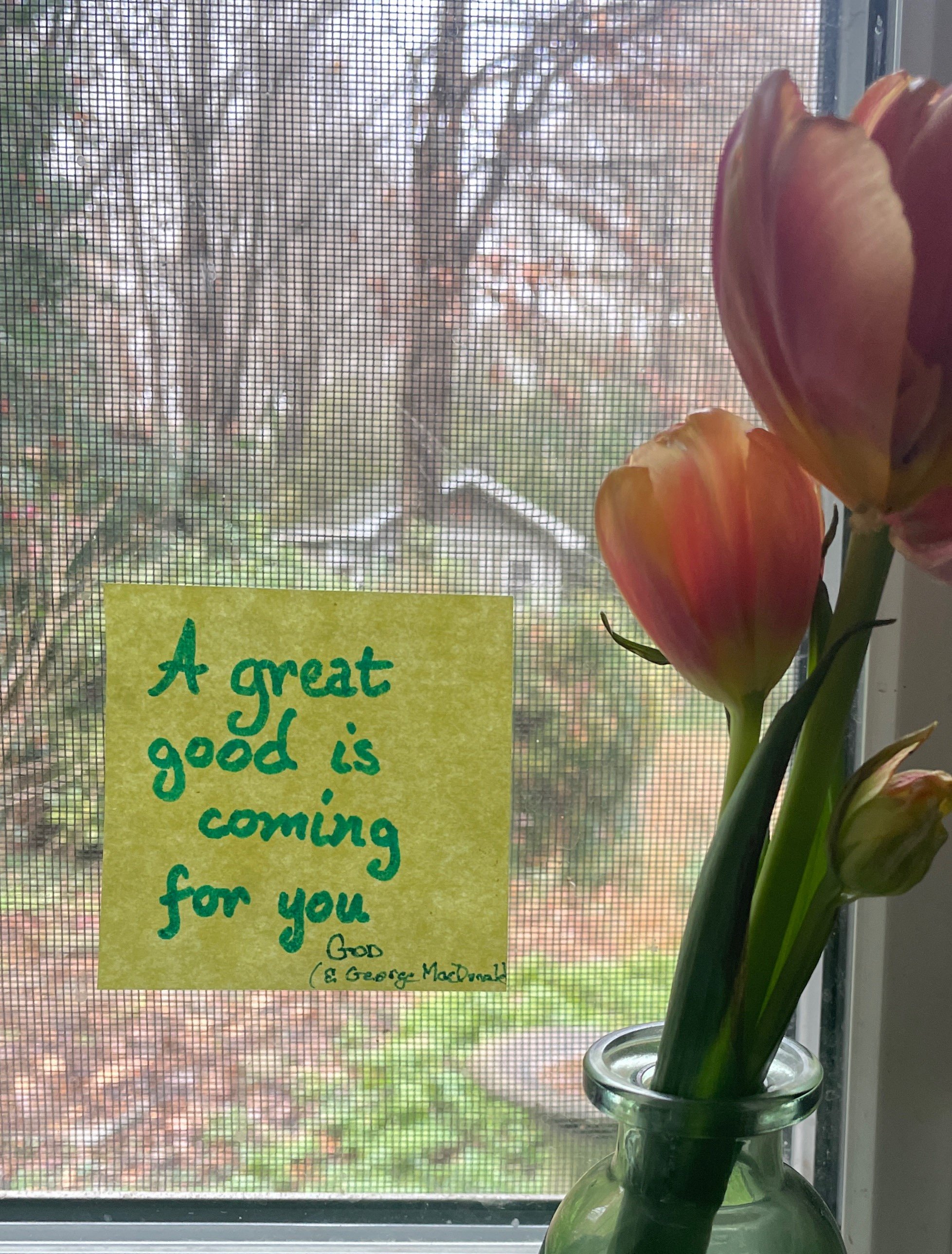
Photo credit: Rosalyn Otto
This truth is borne out in the pages of Scripture. Yes, that good will be fully realized in eternity, when Jesus makes all things new and every sad thing untrue. And also, somehow, even now His goodness and steadfast love are chasing us down and overtaking us all the days of our lives (Ps 23:6). As the psalmist declared, “I remain confident of this: I will see the goodness of the Lord in the land of the living” (Ps 27:13). It is our choice whether we will join with the psalmist in that affirmation. That choice is critical because, as John Eldredge has observed, “How we feel about our future has enormous consequences for our hearts now.” More specifically, he states: “Without the anticipation of better things ahead, we will have no heart for the journey.”

Photo credit: Rosalyn Otto
This commitment to anticipate better things ahead, to expect the good, is not reflective of a surface-level positivity nor a naive refusal to face reality. Quite the contrary – it is rooted in an understanding that there is a deeper reality than we can see or that our circumstances may suggest. It’s natural, based on painful experience, to be apprehensive; it’s supernatural, with childlike faith, to expect goodness. But we have every reason to expect good, because we have read the end of the Book, and we know that our Abba Daddy wins. Our Savior, Jesus, wears the victor’s crown. And the Spirit dwells within us, transforming us, “with ever increasing glory” into the likeness of Christ and assuring that our “momentary, light suffering is producing for us an eternal weight of glory far beyond all comparison” (II Cor 4:17). So then, we can, with every expectation of good, say along with Julian of Norwich, “All shall be well, and all shall be well, and all manner of thing shall be well.”

Photo credit: Ibrahim Mushan (Unsplash)
Written by: Rosalyn Otto